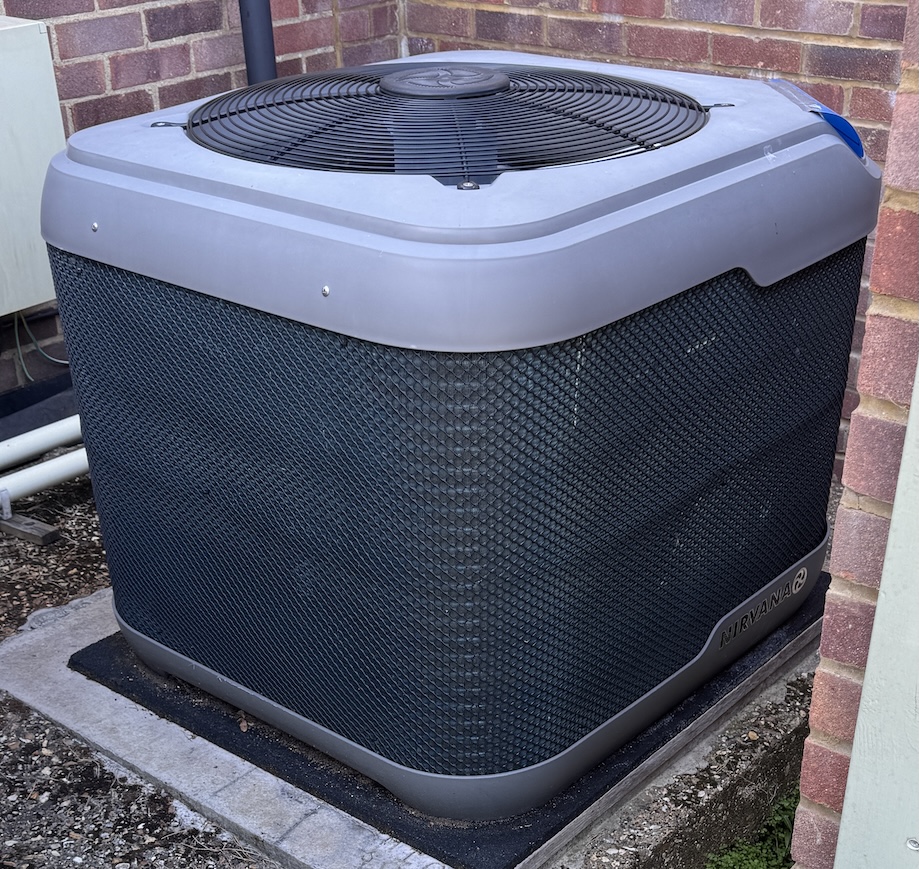
Coming soon – a review of the Nirvana FC70 Air Source Heat Pump.
Air source heat pumps suck in air and refrigerate it to take the heat out of the air and then use a heat exchanger to put the heat into the water flowing through the unit.
To say that I’ve had some problems with my unit is an understatement.
A quick summary of the issues: Failed buttons on control panel – twice. Failed covering on control panel. Failed main circuit board. Failed contactor. Loose connections on main circuit board where the RJ45 cable connects from control panel to main circuit board. And possibly most annoying of all, the electric motor that powers the fan has gradually become so noisy the unit is practically unusable in the quiet neighbourhood that I live in. One year, probably when the unit was 3 years old, I was de-winterising the pool and turned on the heat pump and the motor was squealing really badly. I was supplied a replacement motor by the company who sold me the heat pump, but they didn’t want to pay for someone to install it. A company came to install it and realised the replacement electric motor was the wrong one. So I persevered… until this summer when my patience snapped and I searched locally for a person who could overhaul the electric fan motor. I found someone very local and he cleaned up the motor and replaced the bearings (£280). Amazingly the machine is unbelievably quiet now and seems to operate better than it ever has. Certainly £280 is much cheaper than spending £6000 on a different, quieter, model from a different manufacturer.
Disappointingly I have had all these problems and have been put in touch with the head of engineering at Nirvana – even had an email or two from him. But they just cannot support these units in the UK. It might be better in the US/Canada, but here in the UK it seems there’s always a shortage of parts. I’m also not at all convinced they are designed well for UK weather. The motor is a case in point – it basically gets water blown up at it when it is raining and the unit is running. So the bearings and the insides of the motor were affected. I was lucky I found someone who could fix. A new motor is £500+, and that’s assuming you can find the right one. I was also lucky that I’m fairly handy and was able to dismantle the machine, get the motor out, get it to the repairers, and get it back in again.
More to follow on the tale of woe, including photos of the motor extraction and re-insertion!